Your Documentation Deserves a Standard
If your team writes the same kind of document more than twice, it deserves a standard.
In Developer Nation's 2025 survey of 10,500+ developers, insufficient or outdated documentation tied for the top challenge among professional developers. When documentation isn't daily work, it's easy to start from scratch each time: a different structure, a different depth, and gaps that only show up when someone needs the missing part.
AI makes writing faster, but it doesn't fix this. You can share a prompt, but people still have to find it, paste it and keep it up to date. That's a habit, not a standard.
The fix is to turn the method into something reusable that the assistant picks up on its own. Most AI assistants now support this through skills and plugins.
A skill captures one job: what to produce, for whom, and what it must cover. The assistant sees only a short description until a task matches. Then it loads the full instructions. That keeps skills lightweight, so a team can install many of them without cluttering every conversation.
A plugin packages one or more skills, plus any tool connections, so a whole workflow can be installed and shared as one unit.
I built one for repo documentation, with two skills:
- Technical documentation for engineers
- A project overview for business stakeholders, with no code and no jargon
The second matters as much as the first. The same repo has two audiences, and engineers rarely have time to explain their work to the people who fund it, sell it or depend on it.
It starts with "document this repo." The plugin asks questions about the project, drafts the documentation, and skips optional sections that don't apply. The required sections are always there.
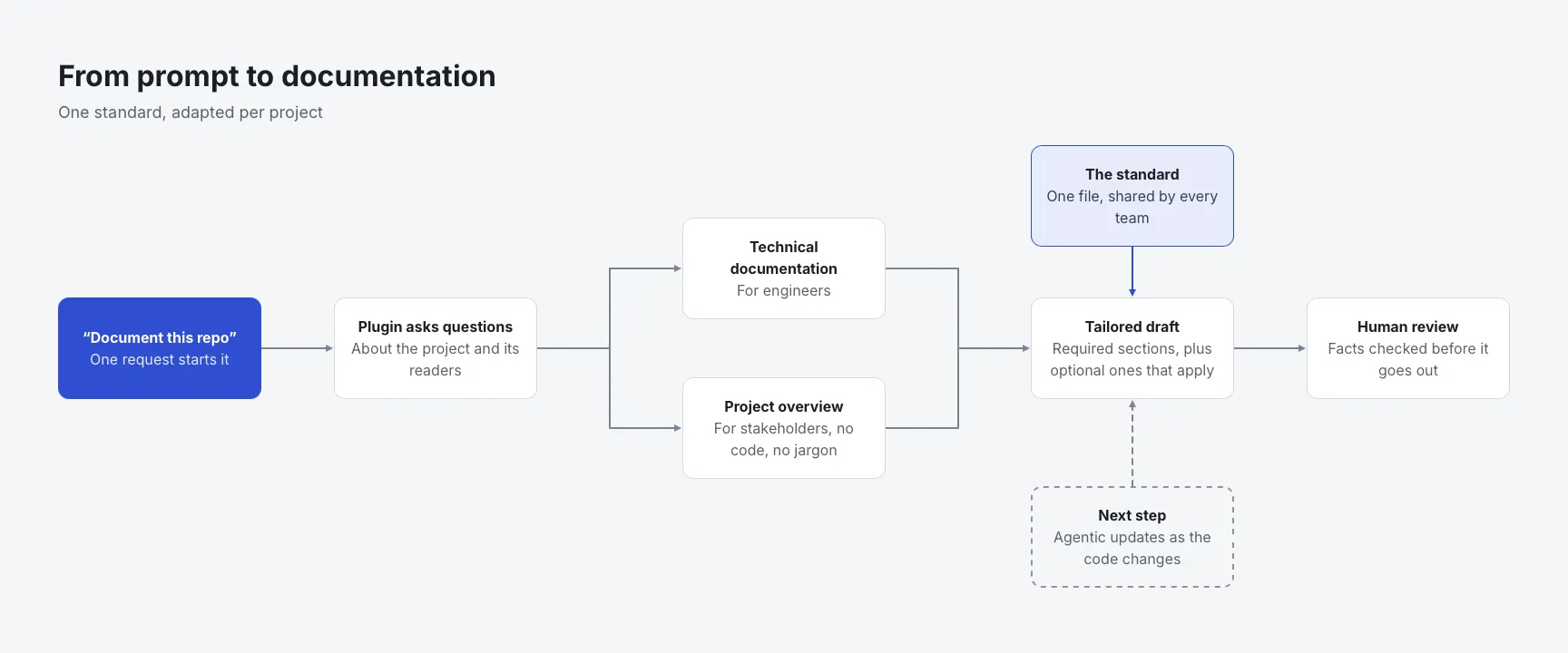
What changed:
- One standard, adapted per project. Every document has the same core sections, so readers know where to look. Optional sections change to fit the repo.
- Gaps are easier to spot. The core is fixed, so a thin or missing answer stands out.
- One place to update, for every team. When a rule changes, one file changes, and every new document follows it. Colleagues and other teams can use it as is or adapt it.
- Less time per document. I haven't measured it yet, but starting from a standard is clearly faster than starting from a blank page.
It has limits. A skill sets the structure, not the facts, so every document still gets read before it goes out. It also helps you create documentation, not keep it current, which is the other half of the problem in the survey. That's my next step: an agentic layer that updates the core documentation as the code changes.
Start with a prompt. When the pattern repeats, package it.